
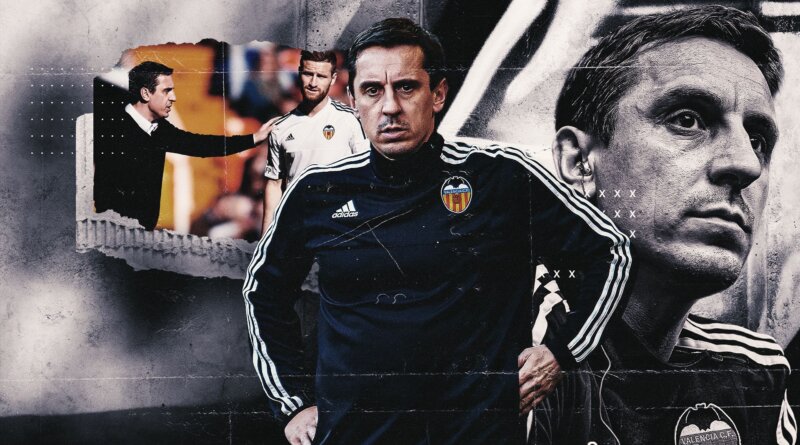
Gary Neville’s Valencia Tenure: Lessons From a Turbulent Reign
Gary Neville’s Valencia tenure stands as one of the most scrutinized coaching spells in La Liga history. Appointed in December 2015, the former Manchester United and England defender entered a club with high aspirations but left just four months later, his reputation dented and his coaching ambitions dashed.
How Gary Neville Became Valencia Manager
The Gary Neville Valencia story began with surprise across the football world. Despite a distinguished playing career and a reputation as a sharp pundit, Neville had no prior club coaching experience, little familiarity with Spanish football, and no Spanish language skills. His swift appointment at Valencia was largely attributed to his business ties with club owner Peter Lim, whose own popularity was already waning among the Mestalla faithful.
Neville’s arrival was met with cautious optimism, bolstered by encouragement from England’s then-director of football, Dan Ashworth, who saw the move as a potential stepping stone to the England job. However, club legend Santi Canizares voiced doubts, warning that Valencia was no place for apprentices. It didn’t take long for those words to prove prophetic.
Gary Neville Valencia Tenure: Early Struggles and Tactical Missteps
Neville’s managerial reign started with a Champions League exit, losing 2-0 to Lyon as tactical naiveté saw him convert a 4-3-3 to a risky 4-2-4, ultimately ceding control of midfield. Domestic struggles soon followed: two points from his first three league games and a brief glimmer of promise with a 2-2 draw against Real Madrid, which ironically cost Rafa Benitez his job, but momentum never materialized.
Embarrassment at Camp Nou and Media Pressure
The nadir arrived in the Copa del Rey, where Neville’s team was humiliated 7-0 by Barcelona. Luis Enrique showed no mercy, keeping his star-studded attack on the pitch and snubbing Neville’s handshake, a moment Neville later described as Enrique “sending a message that I didn’t belong.” The Mestalla crowd, along with the local media, turned. Chants of “Gary go now” filled the air, and Neville’s confidence began to erode.
Language Barriers and Dressing Room Disconnect
Communication proved a major obstacle. Neville admitted to feeling embarrassed leading training in broken English via a translator. Bringing in Pako Ayesteran as an assistant helped, but the disconnect persisted. “The biggest problem Gary had was not being able to express himself,” Ayesteran later remarked, highlighting how crucial passion and direct communication are for a coach.
Brief Respite Then Further Decline
A 10-match wait for his first league victory ended with wins over Espanyol and Granada, and a Europa League thrashing of Rapid Vienna provided hope. However, results soon nosedived, with five defeats in seven matches culminating in a 2-0 home loss to Celta Vigo. By then, Valencia were just six points above the relegation zone, having been mere points from Champions League spots at Neville’s arrival.
The symbolic low came during the Las Fallas festival, when a burning effigy of Neville’s face—alongside the infamous 7-0 Barcelona scoreline—was paraded through the streets. By the next match, chants for his dismissal were deafening.
The Aftermath of Gary Neville’s Valencia Spell
Following his dismissal, Ayesteran took over but fared even worse, and a rapid succession of managers ensued. Only Marcelino, who won the Copa del Rey and achieved consecutive top-four finishes, found sustainable success under Lim’s contentious ownership.
Neville’s time at the Mestalla has been retrospectively viewed as just one chapter in the club’s turbulent recent history. Ownership instability, fan unrest, and frequent managerial changes plagued Valencia long after Neville’s departure, suggesting deeper structural issues than any single coach could resolve. For more news, visit for more news.
Voices From the Dressing Room
Some players have since defended Neville. Guilherme Siqueira admitted, “Tactically we understood what he wanted but couldn’t execute it.” Striker Alvaro Negredo believed Neville could have thrived in England, citing his positive attitude and willingness to improve.
Not all were so generous. Ex-president Fernando Roig labeled Neville “the worst coach I have ever seen.” Neville himself, in reflection, admitted the experience was overwhelming: “This idea that I thought I could have all the businesses, the media career and be a head coach was nonsense, absolute nonsense. Stick in your lane, stick to what you’re good at.”
Opinion: Gary Neville’s Valencia Experience—A Harsh Lesson in Football Realities
While Gary Neville’s Valencia tenure is often cited as a cautionary tale, it’s clear he was not solely to blame for the club’s woes. Thrust into a volatile environment with limited support and communication barriers, his rookie mistakes were amplified by the club’s broader dysfunction. Ultimately, Neville’s story underscores the perils of inexperience at the top level, but also highlights the importance of structure, stability, and clear communication—elements that were sorely lacking during his brief, turbulent reign.
Your global gateway to nonstop football coverage:
News Goal
Share this content: