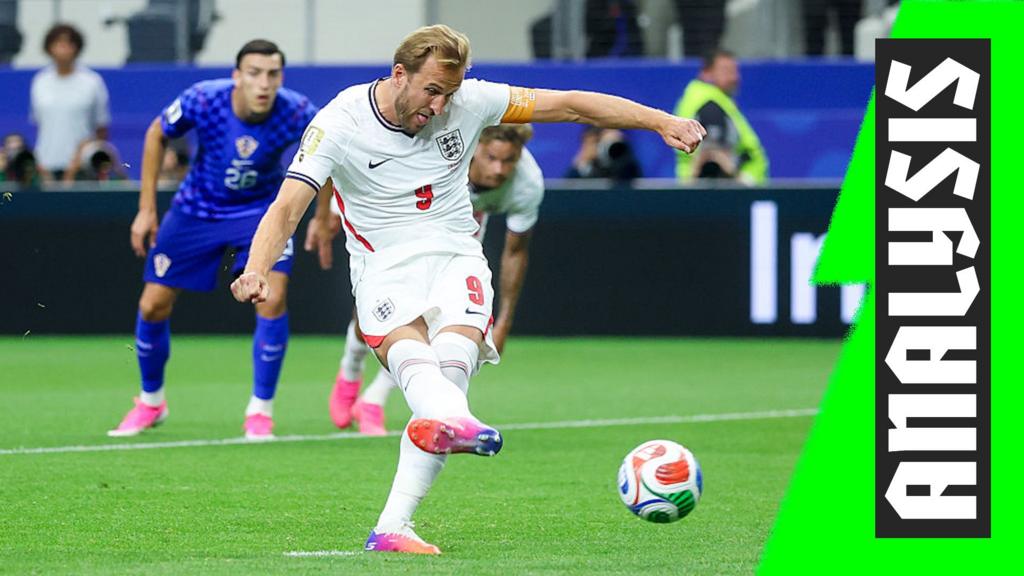
Harry Kane’s reputation as one of football’s most dependable penalty takers is built on more than composure. In a BBC Sport video analysis, Joe Hart and Wayne Rooney examined the England captain’s evolving technique and the level of preparation that goes into his spot-kicks, offering a reminder that elite finishing is often the product of repetition, detail and constant adjustment.
For supporters, the discussion matters because penalties can define tournament runs, knockout ties and title races. A striker who can repeatedly convert under pressure gives a team a tactical advantage before the ball is even placed on the spot. Kane has long carried that responsibility for England, and any insight into how he maintains that standard is relevant not just to his individual record, but to the wider confidence of the side around him.
Why Kane’s penalty work matters
The BBC segment centres on the idea that Kane’s method has not stood still. Hart and Rooney focused on the changes in his technique and the work behind them, which is significant because penalty takers often have to evolve as opponents study their habits. At the highest level, the margin between scoring and missing can come down to timing, body shape, disguise and the ability to stay calm when the pressure rises.
That is especially important for England, where Kane’s role extends beyond scoring goals in open play. As captain and focal point, he is expected to deliver in decisive moments. When a team’s main forward is also its most trusted penalty taker, the psychological value is substantial: defenders know a foul in the box can be costly, while teammates gain reassurance from having a proven finisher in reserve.
Hart and Rooney’s perspective adds context
Hart and Rooney bring different but complementary perspectives to the analysis. Hart’s background as a goalkeeper gives him a natural understanding of what penalty takers try to hide, while Rooney’s experience as a forward and England captain adds insight into the mentality required to take responsibility in high-stakes moments. Their assessment frames Kane’s routine as a professional craft rather than a simple technical action.
That broader context is useful for readers because penalty success is often judged only by the final result. The BBC discussion suggests the process is more nuanced: preparation, adaptation and attention to detail all matter. For Kane, that work helps explain why he remains such a central figure for club and country, and why his penalty record continues to attract analysis whenever major tournaments or decisive matches come into view.
For England supporters, the takeaway is straightforward. A captain who keeps refining his technique is a captain who is trying to stay ahead of the game. In tournament football, that kind of marginal gain can be decisive.
Source note: This article was prepared using publicly available information from BBC Sport and expanded with editorial context.
Share this content: