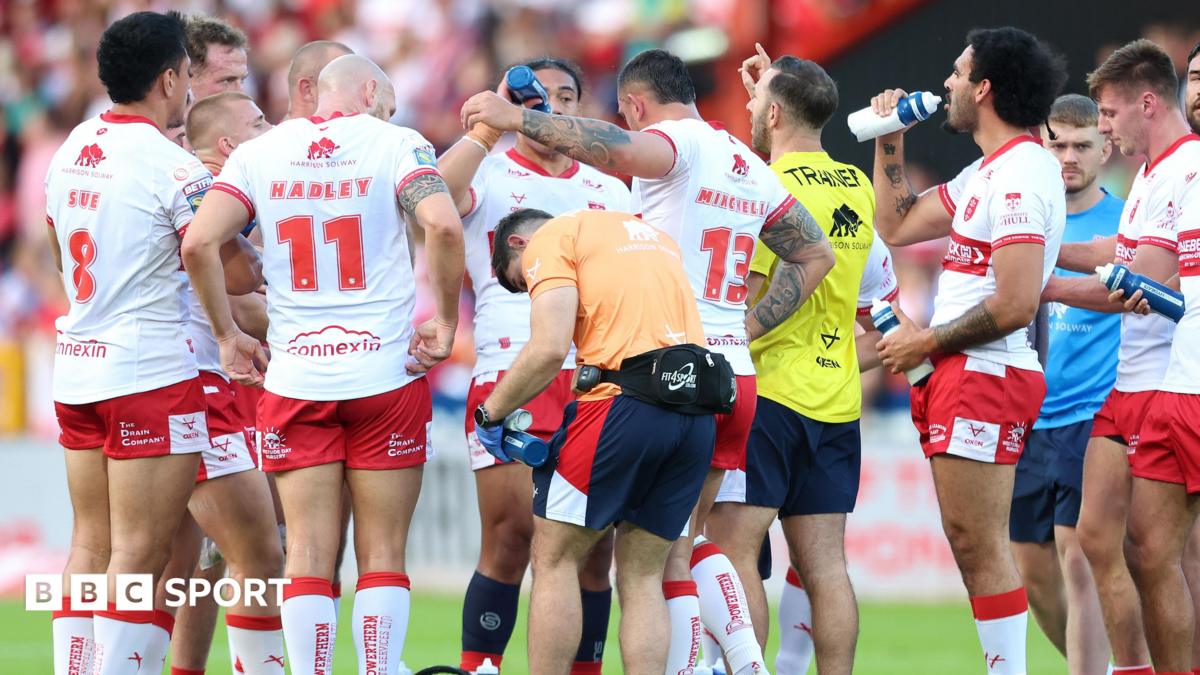
The Rugby Football League’s decision to introduce hydration breaks this weekend is a practical response to a weather problem that can quickly become a performance and welfare issue. With temperatures rising, the governing body has opted for two 90-second stoppages in games to help players cope with the conditions, a move that places player safety ahead of the usual rhythm of play.
For supporters, the change is a reminder that modern rugby league is increasingly shaped by scheduling, venue conditions and welfare protocols as much as by tactics and momentum. In a sport built on repeated high-intensity collisions and relentless defensive effort, even a short pause can matter. It gives players a chance to recover, coaches a brief window to reset instructions and medical staff a better opportunity to monitor signs of fatigue or heat stress.
Why the breaks matter
Hydration stoppages are not just about comfort. In extreme heat, dehydration and overheating can affect decision-making, reaction time and physical output, all of which are critical in a game where line speed, tackle efficiency and support play depend on sharpness. A short break can help reduce the risk of cramp, exhaustion and avoidable errors, especially in matches played at a high tempo.
The RFL’s move also reflects a broader trend across elite sport: governing bodies are being forced to adapt competition rules to environmental conditions. That is particularly relevant in a weekend where some fixtures are expected to be played in covered stadiums, where the heat may not be as severe but the stoppages will still apply. That has already prompted complaints about the length of the interruptions.
What the criticism means
The objections are understandable. Rugby league supporters value flow, intensity and the sense that momentum can swing in an instant. Any stoppage risks breaking that rhythm, and in venues where the temperature is not a major factor, the logic of a full three-minute interruption may be questioned. Yet the governing body is clearly prioritising consistency and player welfare over case-by-case discretion.
From a football-style editorial perspective, the story is a useful example of how elite sport balances spectacle with safety. The immediate impact is likely to be modest, but the longer-term significance is bigger: if extreme weather becomes more common, more competitions may need to formalise similar measures. For players, that means a slightly different physical and tactical challenge. For fans, it means accepting that the game’s conditions are changing, even if the contest itself remains the same.
In that sense, the RFL’s hydration-break policy is less a disruption than an adaptation. It may not please everyone, but it is a sign that player welfare is becoming a non-negotiable part of the modern game.
Source note: This article was prepared using publicly available information from BBC Sport and expanded with editorial context.
Share this content: