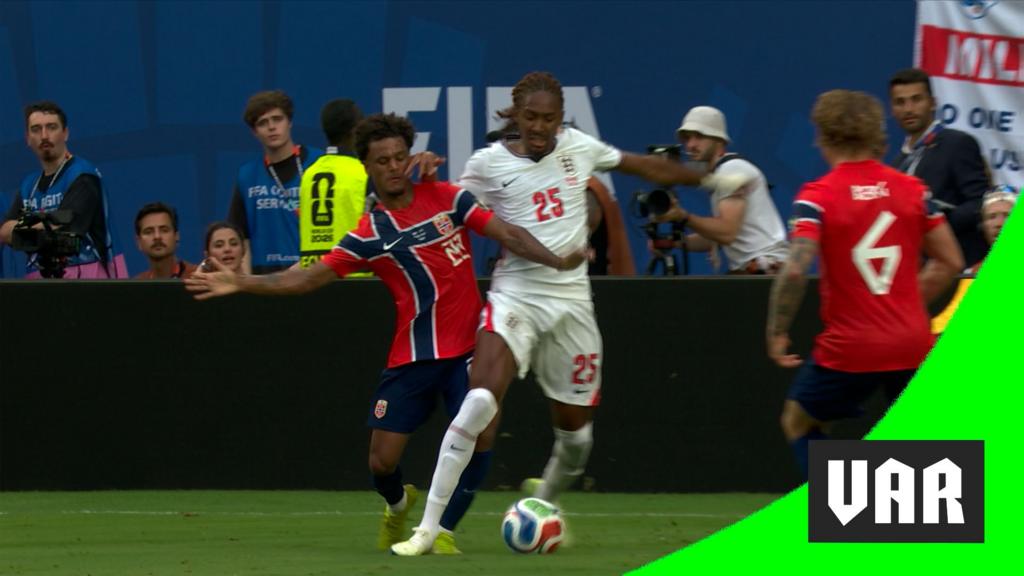
England were left frustrated after a penalty decision was overturned following a VAR review in Miami, with the key question centring on whether Djed Spence initiated the contact that led to the original award. The incident, involving Norway’s Oscar Bobb, came in the first half of extra time and quickly became the sort of marginal call that can define knockout football.
For supporters, these moments are rarely just about one whistle. They speak to the wider tension between on-field instinct and video review, and to the fine margins that now shape international matches at the highest level. England’s reaction will likely be one of annoyance, particularly because a penalty in extra time can alter the rhythm of a game and force an opponent to chase from a position of immediate pressure.
Why the VAR call mattered
The central issue was not whether contact occurred, but who created it. That distinction is crucial in modern officiating, where referees and VAR officials are asked to separate genuine fouls from situations where an attacker or defender may have engineered the collision. In this case, the review concluded that Spence had initiated the contact, leading to the overturning of the penalty.
For England, that outcome removes a potential route to control in a tense period of the match. For Norway, it was a significant defensive reprieve, because surviving a penalty scare in extra time can shift momentum and belief immediately. These decisions often become talking points long after the final whistle because they sit at the intersection of law, interpretation and game management.
What it means for England and Norway
From an England perspective, the episode will feed into broader debate about how attacking players win penalties and how consistently those situations are judged. Djed Spence’s involvement also adds an individual layer to the discussion, as full-backs and wide defenders are frequently exposed in one-versus-one situations where body position and timing are decisive.
For Norway, the overturned call will be viewed as a major escape, especially in a match where every detail matters. Oscar Bobb’s role in the incident underlines how quickly a wide attacking move can turn into a decisive officiating review. In a game played at such a high emotional and physical intensity, the ruling reinforced how VAR continues to influence the biggest moments in international football.
Whether supporters see the decision as correct or harsh, it is another reminder that penalty incidents are now judged not only by the initial contact but by the sequence that created it. In matches decided by small margins, that can be the difference between celebration and frustration.
Source note: This article was prepared using publicly available information from BBC Sport and expanded with editorial context.
Share this content: