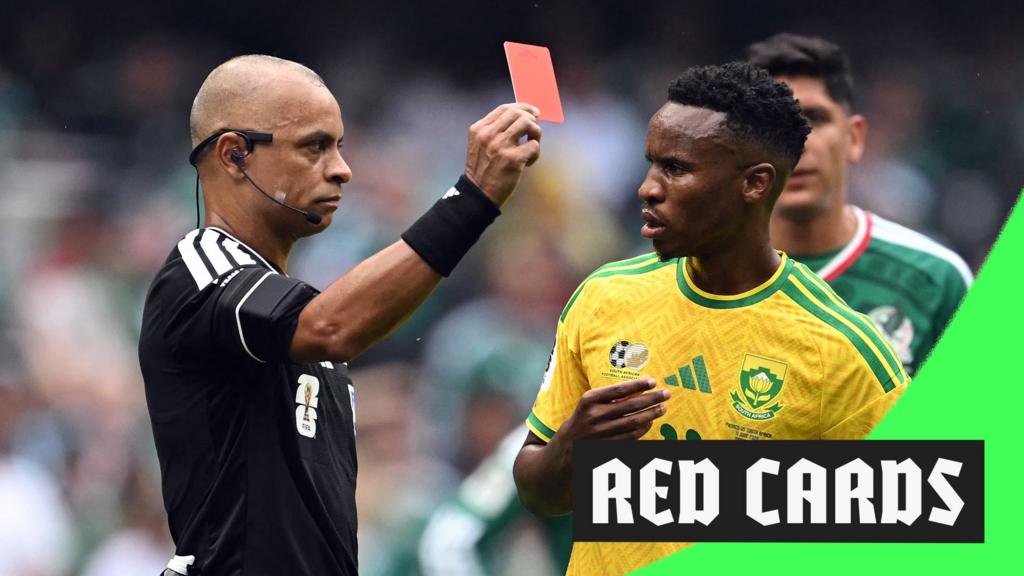
The opening match of a World Cup is usually remembered for ceremony, anticipation and the first glimpse of how the tournament might unfold. Instead, the 2026 World Cup began with a disciplinary storm in Mexico City, where referee Wilton Pereira Sampaio sent off three players in a game that immediately underlined how quickly control can slip in football’s biggest event.
South Africa’s Yaya Sithole and Themba Zwane were both shown red cards, while Mexico defender Cesar Montes also saw red in the same match at the Mexico City Stadium. Even without the full tactical picture of the contest, the scale of the dismissals tells its own story: this was not a routine opener, but a match that became defined by discipline, pressure and the referee’s authority.
A chaotic start to the tournament
For supporters, a World Cup opener is supposed to set the tone for a month of football. When three red cards arrive in the first game, the narrative changes immediately. Players are forced to adapt, coaches must rethink shape and substitutions, and the emotional temperature of the tournament rises before it has properly settled.
Red cards in a high-profile international match can have consequences beyond the final whistle. They affect selection for the next game, alter group-stage momentum and can leave a team carrying avoidable pressure into the rest of the competition. For South Africa and Mexico, the immediate concern is not just the result of this match, but the potential disruption to preparation and squad balance going forward.
Why the dismissals matter
From a tactical perspective, playing with ten men changes everything. Defensive lines have to drop deeper, pressing becomes less aggressive and attacking transitions become harder to sustain. If both sides lose players, the game can become fragmented, with space opening in unexpected areas and rhythm disappearing entirely.
That matters in a World Cup, where margins are thin and every point can shape qualification. A team that loses discipline early may spend the rest of the group stage trying to recover not only points, but also confidence. For the referee, too, such a match becomes a major talking point, because the opening fixture often sets the standard for how physical contact and dissent will be handled throughout the tournament.
BBC’s video report on the incident is not available in all locations, but the key facts are clear: the 2026 World Cup began with three red cards, and the tournament’s first match already carried the kind of volatility that can define a campaign. For fans, it is a reminder that World Cup football is rarely predictable, and that the pressure of the occasion can turn even the opening game into a test of discipline as much as quality.
Source note: This article was prepared using publicly available information from BBC Sport and expanded with editorial context.
Share this content: